
Imagine hiring a brilliant chemist who, despite having read every synthesis paper published in the last decade, walks into your lab on their first day and says: "I don't know anything about how reactions work here. Let's start over." That's exactly what today's Bayesian optimization tools do, every single campaign.
Public repositories like Pistachio and USPTO contain tens of thousands of experiment results: catalyst-substrate combinations, ligand pairings, solvent choices, and their measured yields. A medicinal chemist setting up a new campaign in 2026 already has, in principle, a vast prior of what works, what fails, and why. And yet the dominant Bayesian Optimization techniques for reaction optimization throw all of that knowledge away at campaign start.
At MSTACK AI, we have built BEACON, a Bayesian-guided continual knowledge graph embedding framework that gives your BO surrogate a chemistry-aware memory, built from real reactions, that sharpens from round one.
Why every campaign starts blind
Multi-task Bayesian optimization (MTBO) is the prevailing approach for reaction condition optimization. It's powerful: a Gaussian process surrogate learns across multiple related tasks simultaneously, sharing statistical signal between campaigns through a learned coregionalization matrix. But it has a fundamental architectural gap. It requires explicit per-task training data and a fixed task index. It cannot ingest the heterogeneous, ever-growing pool of public reactions.
Other chemistry-BO approaches either hardcode structural priors rigidly into the kernel, making them inflexible and acquisition-coupled, or warm-start from related campaigns that had to themselves be run first. None of them integrate a continually updated structural manifold of historical chemistry into the surrogate's input space.
The consequence is tangible and costly: on our Direct Arylation benchmark runs with 20 paired seeds, bare MTBO exhausts its full 55-well budget without reaching the top-yield threshold in 14 out of 20 seeds. That's 70% of campaigns hitting a dead end.
BEACON: a chemistry-aware memory for BO
BEACON's core idea is clean: instead of modifying the acquisition function or replacing the surrogate, we enrich what the surrogate sees. We take historical reaction data, encode it as a typed knowledge graph, train entity embeddings that capture structural and functional chemistry, and concatenate a compact projection of those embeddings onto the standard Morgan fingerprint. The surrogate stays the same. The acquisition stays the same. Only the input space gets richer.
The Reaction Knowledge Graph (RKG)
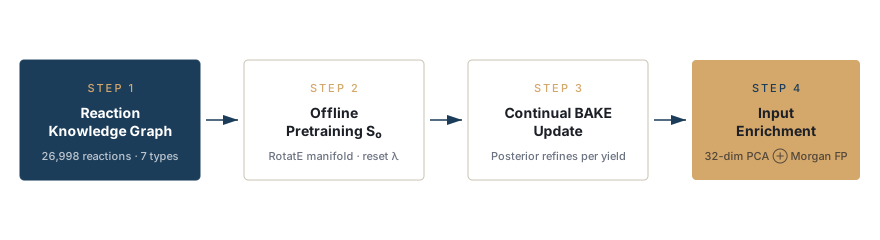
The RKG encodes reactions as a typed graph with seven entity types, Reaction, Substrate, Catalyst, Ligand, Solvent, ReactionClass, and Condition, and fifteen relation types. Crucially, yields live as continuous numerical edge attributes rather than discretized nodes, preserving the analog signal from HTE plates. The graph is populated from ~27K Pistachio reactions spanning Buchwald-Hartwig, Suzuki-Miyaura, and Direct Arylation chemistry. After type-aware canonicalization, this collapses to 5,852 unique entities and roughly 1.1M triplets.
Beyond the standard "uses" relations, we compute four chemistry-enriched similarity edges for same-type entity pairs using RDKit descriptors: structural similarity (Tanimoto ≥ 0.6 over ECFP4), electronic similarity (MolLogP/TPSA as a HOMO/LUMO proxy), steric similarity (molecular weight and rotatable bonds), and thermodynamic similarity (BertzCT as a ΔpKa proxy). These edges allow the embedding to cluster reagents that are similar in the ways that matter for yield prediction.
Bayesian Adaptive Knowledge Embedding (BAKE)
Standard knowledge graph embedding methods give you a point estimate, a fixed vector for each entity. BEACON uses BAKE, which maintains a full Gaussian posterior over each entity. This matters for two reasons: the uncertainty channel can calibrate the GP surrogate, and a precision-decay variant (γ = 0.95) prevents "precision rigidification," where early observations lock embeddings in place and block later learning. Every 8 observations, BEACON fires a posterior-only BAKE update; a full retrain triggers when novel chemistry enters the campaign.
The posterior reset trick
One subtle but important design decision: at the start of every new campaign, we reset all per-entity precisions to an uninformative floor (λ = 0.01) while keeping the embedding means intact. Without this reset, the high precisions built up during S₀ pretraining make every entity appear "well-known" to the surrogate. It exploits the chemistry prior blindly, without exploring. The reset restores exploration while keeping the geometry of the embedding manifold learned from 27K historical reactions.
Three benchmarks, one honest picture
We ran BEACON+MTBO against a matched MTBO baseline across three published HTE benchmarks, Doyle Buchwald-Hartwig, Reizman Suzuki-Miyaura, and Shields Direct Arylation, at 20 paired seeds with identical Latin-hypercube initialization draws and a 55-well budget. The metric we care about is N₉₀: the number of wells needed to reach 90% of the plate-maximum yield. Lower is better.
N₉₀ across three benchmarks
Wells to reach 90% max yield. Lower is better.
Direct Arylation
−26.8%Doyle Buchwald-Hartwig
−9.5%Reizman Suzuki
TieOn Direct Arylation, BEACON+MTBO reduces mean N₉₀ by 26.8%, from 44.8 to 32.8 wells, with paired Wilcoxon p = 0.0058. More practically: the rate of "death spirals" (seeds that exhaust the full 55-well budget without finding a good condition) drops from 14/20 to 7/20. That's the difference between a campaign that works and one that doesn't.
On Doyle Buchwald-Hartwig, BEACON shows a directionally consistent 9.5% improvement (44.9 → 40.7), though this doesn't cross the p < 0.05 threshold at 20 seeds, likely due to the bimodal N₉₀ distribution at this benchmark (early hit or complete failure). The trend is real; the sample size is the bottleneck.
On Reizman Suzuki, BEACON and MTBO tie (p = 0.60). We're transparent about why: only 9 of 46 Suzuki reagent SMILES in the candidate pool intersect with our S₀ pretraining corpus. The knowledge graph's input channel is sparsely populated for this benchmark, and the bare MTBO baseline already saturates this small 385-candidate pool efficiently. This isn't a framework failure. It's a corpus coverage gap, and it's fixable by ingesting additional Suzuki-specific reaction data.
Four things worth knowing
Ablation · 01
The gain is from chemistry, not clever math
We ran BEACON with EI instead of UCB on Direct Arylation: identical N₉₀ sequences, [7, 6, 6, 55, 16] on both. The acquisition function doesn't drive the improvement. The chemistry manifold from S₀ does.
Design · 02
Plug in, don't replace
BEACON wraps the MTBO surrogate rather than replacing it. The MultiTaskGP, its ICM coregionalization, and UCB acquisition are all preserved. Input enrichment and surrogate architecture are fully decoupled.
Ablation · 03
KGE without pretraining is noise
Adding KGE features initialized at random to the surrogate gives essentially no improvement (44.8 → 44.5 N₉₀). S₀ pretraining is the load-bearing component. It's what turns a vector of numbers into a structural prior.
Deployment · 04
Coverage predicts benefit
You can gate deployment on a simple canonical-SMILES coverage statistic before running a campaign. If your reagents aren't in S₀, BEACON reduces to baseline, and you can tell before you spend a single well.
The road ahead for BEACON
BEACON is the first step toward a broader vision: reaction optimization that doesn't forget. The current framework has natural extensions we're actively working on.
- 01
Expanding S₀ coverage.
The Suzuki tie is a data problem, not an architecture problem. We're ingesting additional Pistachio sub-corpora and open HTE datasets to close the Suzuki coverage gap and extend to C-O, C-N, and other cross-coupling families relevant to our ChemStack AI campaigns.
- 02
Batch BO integration.
The current BEACON loop is sequential (batch size 1). Extending to batch acquisition, q-EI with diversity constraints for example, is straightforward architecturally and high-value practically, since most HTE platforms can run 8 to 32 wells in parallel per round.
- 03
Tree-based surrogate compatibility.
Our pilot experiments showed that BEACON-style KGE enrichment degrades performance with Random Forest surrogates: axis-aligned splits can't exploit continuous low-variance KGE dimensions. A kernel-recasting or RF-specific acquisition is the natural fix, and opens BEACON to the considerable installed base of RF-based BO systems.
Bring chemistry-aware AI to your campaigns. BEACON is one component of ChemStack AI, our AI-native B2B product. We are running a closed beta with selected pharma and materials partners through Q3 2026.
Jahnvi Yadav · Raja Sekhar Pappala
AI researchers at MSTACK AI, the team behind Chemstack.